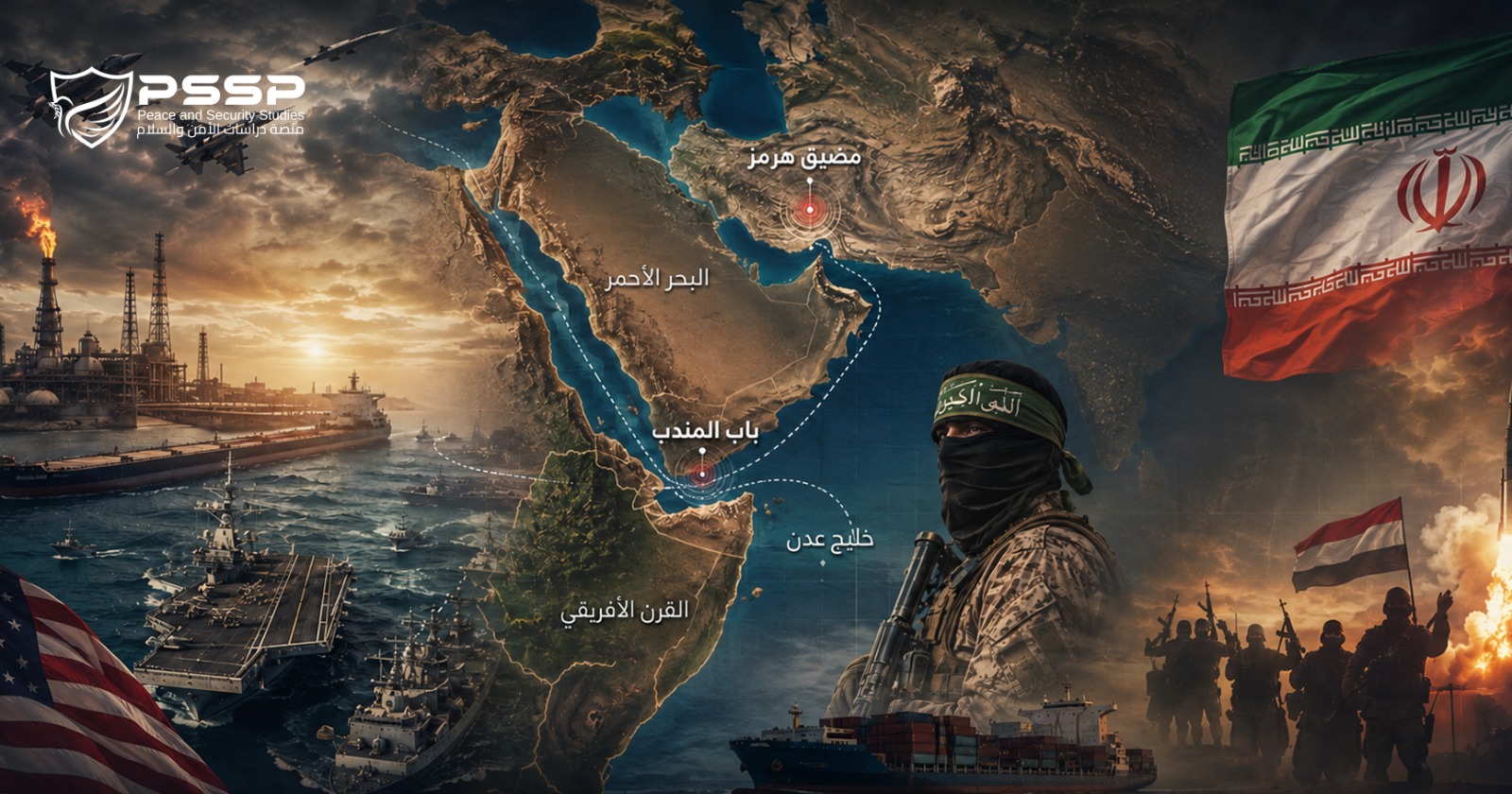
From the Strait of Hormuz to Bab el-Mandeb: The Repercussions of the Iranian War on the Security of the Red Sea and the Horn of Africa
From the Strait of Hormuz to Bab el-Mandeb: The Repercussions of the Iranian War on the Security of the Red Sea and the Horn of Africa

From the Strait of Hormuz to Bab el-Mandeb: The Repercussions of the Iranian War on the Security of the Red Sea and the Horn of Africa
The military escalation associated with Iran represents one of the most significant strategic variables in the regional and international environment. This is not only due to its direct impact on the security of the Arabian Gulf and the Strait of Hormuz but also because of its ability to produce shockwaves that extend toward the Red Sea, Bab el-Mandeb, and the Horn of Africa. This region is no longer read as separate geographical spaces; rather, it has become part of a single security system where maritime corridors, energy markets, supply chains, armed groups, foreign military bases, and competition among regional and international powers intersect. This situation assessment stems from a primary premise: any Iranian war, whether a direct confrontation with the United States or Israel, or an indirect escalation via allies, will not remain confined to the Strait of Hormuz. Iran possesses a regional network of influence capable of expanding the scope of strategic pressure. The Houthis in Yemen emerge as the most critical actor capable of transferring the impact of escalation to the Red Sea and Bab el-Mandeb. The importance of the Red Sea is increasing because it is no longer merely a maritime route between Asia and Europe; it has become an arena of direct conflict among multiple powers. On one hand, international powers seek to protect trade and energy; on the other, some armed actors use it as a political and security pressure card. In this context, the Horn of Africa appears to be in a sensitive position. It is not necessarily a direct party to the war, but it is one of the regions most vulnerable to its repercussions due to its geographical location and the fragility of some of its states.
The Strategic Context: From Energy Security to the Security of Maritime Corridors
The danger of the escalation linked to Iran lies in the fact that it occurs within a region containing the world’s most critical maritime chokepoints. The Strait of Hormuz is a central transit point for oil and gas from the Gulf, while Bab el-Mandeb is the connecting point between the Red Sea, the Gulf of Aden, and the Arabian Sea. Therefore, any threat to the Strait of Hormuz not only affects energy markets but also compels regional and international powers to reassess the security of alternative and connected corridors, primarily Bab el-Mandeb. (1)
The US Energy Information Administration indicates that Bab el-Mandeb is the southern chokepoint of the Red Sea, and that flows of crude oil and petroleum products dropped by more than half during the early months of 2024 due to Red Sea disruptions. Indicators reveal that maritime threats do not require a complete closure of the strait to affect the global economy; merely raising the security risks is enough to reduce tanker traffic and alter the calculations of shipping and insurance companies. (2)
The Red Sea disruptions have placed the movement of goods and supply chains at serious risk, especially as commercial ships and oil and gas tankers have been forced to reroute toward the Cape of Good Hope. This has contributed to increased maritime distances and logistical costs. In this context, a US-Israeli war on Iran, or a wide-scale escalation, acts as a crisis multiplier. The Red Sea is suffering from disruptions linked to Houthi attacks, which has impacted shipping traffic in both the Suez Canal and the Horn of Africa—a region already experiencing a fragile situation due to crises in Sudan, Somalia, and Ethiopia. Consequently, any new escalation in the region will add a new dimension to the regional security of the Horn of Africa. (3)
The Red Sea and Bab el-Mandeb as an Extension of the Conflict with Iran
The danger posed by the Iranian side does not lie solely in Iranian military capabilities, but rather in the nature of the network of allies Tehran possesses in the region. Iran can increase the cost of war for its adversaries through irregular actors in Yemen, Iraq, and Lebanon. The Houthis hold a special position because they are geographically stationed near Bab el-Mandeb and possess military tools that enable them to threaten ships in the Red Sea and the Gulf of Aden. The Red Sea crisis since 2023 has proven that the Houthis are capable of turning the sea into a space for international pressure. Targeting commercial ships and oil tankers does not only lead to direct material losses; it changes the behavior of shipping companies, raises insurance costs, and lengthens transit times because crossing the high-risk Red Sea becomes a liability. (4)
In the event of widening military confrontations, Bab el-Mandeb could turn into a parallel pressure front to the Strait of Hormuz. Iran may find that activating the Yemen front is a means to raise the cost of war for regional and international parties. Conversely, the Houthis may see escalation as an opportunity to enhance their regional standing and portray themselves as part of a transnational “resistance axis,” rather than merely a local actor within Yemen. However, this approach carries extensive risks. Escalation at Bab el-Mandeb does not only harm Iran’s adversaries but also affects global trade and African economies. Thus, using the sea as a pressure card could turn into a massive destabilizing factor with uncontrollable consequences. (5)
Repercussions of the Iranian War on the Horn of Africa
The Horn of Africa is considered one of the regions most susceptible to the repercussions of Iranian escalation because it lies at the heart of the geographic sphere affected by the security of the Red Sea and the Gulf of Aden. Countries like Djibouti, Somalia, Eritrea, Sudan, and Ethiopia are connected to varying degrees to maritime corridors, whether through ports, trade, energy, humanitarian aid, or military bases. (6)
Djibouti is at the forefront of the affected countries, given its close proximity to Bab el-Mandeb and its hosting of multiple foreign military bases. This location grants it significant strategic importance but also makes it more prone to involvement in maritime deterrence and protection arrangements. The more tension increases in the Red Sea, the more important Djibouti becomes as a logistical and military hub, and the greater the risk of it turning into a focal point in a broader regional-international conflict. (7)
Somalia, on the other hand, faces a more fragile situation. State weakness, an extensive coastline, the presence of the Al-Shabaab movement, and smuggling networks are all factors that make any disruption in the Gulf of Aden and the Red Sea a compounded threat. If international naval forces are preoccupied with countering the Houthis or protecting ships in the Red Sea, security vacuums may emerge that could be exploited by piracy networks off the Somali coast. Recent fears have already surfaced regarding the resurgence of Somali piracy amidst the international forces’ preoccupation with the Red Sea and Strait of Hormuz crises, allowing more room for pirates to operate. (8)
Eritrea is located in a sensitive area near Bab el-Mandeb and Yemen and possesses a long coastline on the Red Sea. Although its foreign policies are often characterized by ambiguity, its geographical location makes it a present factor in any security arrangements or regional competition at sea. As for Ethiopia, despite being landlocked, it relies heavily on regional ports, especially the port of Djibouti. Therefore, any rise in shipping, fuel, and insurance costs will reflect on its economy, trade, and food security. (9)
Sudan presents a highly sensitive and complex case due to its internal war, institutional collapse, and the state’s declining ability to control all parts of the country. Thus, any disruption in the Red Sea could exacerbate the Sudanese crisis, whether through arms smuggling, difficulties in delivering aid, or the rising costs of food, medicine, and fuel. Additionally, Port Sudan, by virtue of its location on the Red Sea, may gain increased importance in the calculations of regional and international powers, especially if the war is prolonged and the need for alternative ports or logistical hubs grows. (10)
A US-Israeli war on Iran could produce what might be termed “crisis spillover” into the Horn of Africa. Therefore, we attempt to outline some potential scenarios for the regional security of the Horn of Africa:
Scenario One: Containing the Escalation The war on Iran or the escalation associated with it is contained within certain limits, preventing it from turning into an open regional confrontation. However, tension may continue in the Strait of Hormuz and the Red Sea without reaching an actual closure of Bab el-Mandeb. Sporadic military confrontations or limited threats in the Red Sea persist. Some shipping companies may remain cautious about using the Bab el-Mandeb route, reflecting an increase in shipping and insurance costs. For the Horn of Africa, this context means continued economic and security pressures without a major explosion. Djibouti will be affected due to the increased importance of military bases; Somalia and Sudan will be impacted by the risks of smuggling and piracy, but the situation will remain manageable. Ethiopia will also remain affected by higher transport and energy costs. (11)
Scenario Two: Limited Expansion of Escalation Toward the Red Sea and Bab el-Mandeb This scenario is the most likely. It assumes that the Iranian war or the associated escalation will not turn into a full-scale war but will push toward activating indirect fronts, especially the Houthi front in Yemen. In this case, the Red Sea will become a continuous pressure arena through attacks or threats against ships, soaring insurance costs, and the continued diversion of some vessels toward the Cape of Good Hope. This reflects the nature of modern regional conflicts, where parties often do not desire a full-scale war but use tools of limited pressure to confound adversaries. For Iran, applying pressure via the Houthis may be less costly than a direct naval confrontation. For the Houthis, escalation grants them greater political and military status, making them an influential actor in international security, not just a party to the Yemeni war. For the Horn of Africa, this scenario will be highly impactful. Djibouti will witness an increase in military and logistical activity; Somalia may face the risks of resurgent piracy or expanded smuggling; Sudan may suffer further in the areas of aid and weaponry; and Eritrea may become more significant in military calculations, while Ethiopia bears indirect economic costs due to its reliance on ports. (12)
Scenario Three: A Complex Security Explosion in the Red Sea and the Horn of Africa This scenario represents the most dangerous path. It assumes the war on Iran expands into a multi-front regional confrontation, encompassing the Gulf, Yemen, and possibly Iraq, Syria, and Lebanon, with a significant surge in Houthi attacks on ships. In this case, Bab el-Mandeb could turn into an open conflict zone, maritime traffic would decline drastically, and the likelihood of friction between international and regional powers would increase. The danger of this scenario is that it is not limited to a single threat but combines multiple threats simultaneously: naval attacks, piracy, arms smuggling, armed group activity, port disruption, aid crises, and international military competition. This makes it a “complex crisis” scenario, where security, economic, and humanitarian factors intertwine in a way that is difficult to untangle. Somalia could become the most fragile; it might witness a stronger resurgence of piracy, especially if the effectiveness of international patrols wanes or they are preoccupied with other tasks. Sudan could become more vulnerable to arms smuggling and halted aid. Djibouti might turn into an intensive military and logistical operations center, increasing its importance but also raising its vulnerability to pressure. (13)
Scenario Four: Regional De-escalation and Gradual Decline in Tension This entails the success of international and regional pressures in containing the escalation with Iran, alongside arrangements that reduce the Houthis’ ability to continue threatening navigation. This could be achieved through indirect negotiations, security understandings, international pressure on the conflicting parties, or progress in the Yemeni track. Shipping companies would gradually begin returning to the Red Sea and the Suez Canal, insurance costs would drop, and pressure on African ports would ease. The Horn of Africa countries would benefit from lower transport and energy prices and the stabilization of aid flows. However, the scenario remains contingent on complex factors. It is not enough to simply de-escalate with Iran alone; the Yemeni crisis must also be addressed, the Houthis’ ability to use the Red Sea as a pressure card must be diminished, and more stable regional arrangements for Red Sea security must be built. (14)
Conclusion The situation assessment clarifies that the Iranian war cannot be confined to the Gulf or the Strait of Hormuz. Its repercussions extend to the Red Sea, Bab el-Mandeb, and the Horn of Africa due to the interconnectedness of maritime corridors and the role of armed actors, primarily the Houthis. Although the Horn of Africa countries are not a direct party to the conflict, their political and security fragility, combined with their reliance on ports and maritime trade, makes them highly vulnerable to rising energy and shipping costs, navigation disruptions, and increasing militarization, smuggling, and piracy. Therefore, the most likely scenario is a limited expansion of escalation toward the Red Sea—not a full-scale war, but enough to keep the region in a state of chronic tension. Containing the fallout will require a comprehensive approach linking Gulf security, the resolution of the Yemeni crisis, the stability of the Horn of Africa, and enhanced regional cooperation in the Red Sea.
References:
[1] Raafat Salah El-Din, “The Geostrategic Importance of the Horn of Africa,” Al-Bayan Magazine, Issue 378, November 2018, Accessed: (March 21, 2026),
https://share.google/qVdqrwIuVfvzhSel5
[2] Jalal El-Din Mohamed Saleh, “The Horn of Africa.. Its Strategic Importance and Internal Conflicts,” Alukah Network, July 2013, Accessed: (March 21, 2026),
https://share.google/wXEOs0iuMDPJNnKdi
[3] Nahla Essam El-Dabs, “The Gulf Presence in the Horn of Africa,” Arkan for Studies, Research and Publishing, 2020, pp. 5-6.
[4] Raafat Salah El-Din, previous source.
[5] “The Horn of Africa as a Gulf Strategic Depth,” Siyasat Arabiya, Issue 62, Volume 11, May 2023, p. 141.
[6] Jalal Mohamed Saleh, previous source.
[7] Ahmed Abu Daqqa, “The Red Sea and the Danger of the Concentration of Major Powers,” Al-Bayan Magazine, Issue 383, March 2019, Accessed: (March 21, 2026),
https://share.google/CaW1UPAuNLcpNDlvV
[8] Ayman Samir, “Does the Militarization of the Red Sea Target Chinese Influence in the Region?”, Future for Advanced Research and Studies, March 2024, Accessed: (March 22, 2026),
https://share.google/dIbE8DADEbenr9vBu
[9] Ibid.
[10] Amira Mohamed Abdel Halim, “Military Bases in the Red Sea.. Shifting Balances of Power,” Al-Ahram Center for Political and Strategic Studies, January 2018, Accessed: (March 22, 2026),
https://share.google/P9Dkm0ii58rAIsmck
[11] Ahmed Al-Aghbari, “Establishing Military Bases in Yemen Threatens to Expand the War and Red Sea Security,” Al-Quds Al-Arabi, November 2025, Accessed: (March 23, 2026),
https://share.google/tNLLcGyzISW6Kivsq
[12] Moataz Salama, “The Red Sea.. Strengthening the Geopolitical and Security Incubator is Necessary for the Stability of the Navigational Corridor,” Al-Ahram Center for Political and Strategic Studies, December 2025, Accessed: (March 22, 2026),
https://share.google/RF15C4xxmG91kVPEu
[13] Jad Al-Bustani – Mohamed El-Sayed, “The Map of International and Regional Conflict over the Horn of Africa in the Post-Cold War World,” Arab Democratic Center, June 2021, Accessed: (March 23, 2026),
https://share.google/WUUrFvOaj1Yh1fTmn
[14] Adnan Musa, “International Competition and Regional Penetration in the Horn of Africa,” Taqadum Center for Policies, October 2018, Accessed: (March 22, 2026),
https://share.google/M5COQSCJAadE0XOpB