Shaping the Security Landscape in Mali: From the Fragility of Alliances to the Possibilities of Strategic Vulnerability
Shaping the Security Landscape in Mali: From the Fragility of Alliances to the Possibilities of Strategic Vulnerability

Shaping the Security Landscape in Mali: From the Fragility of Alliances to the Possibilities of Strategic Vulnerability
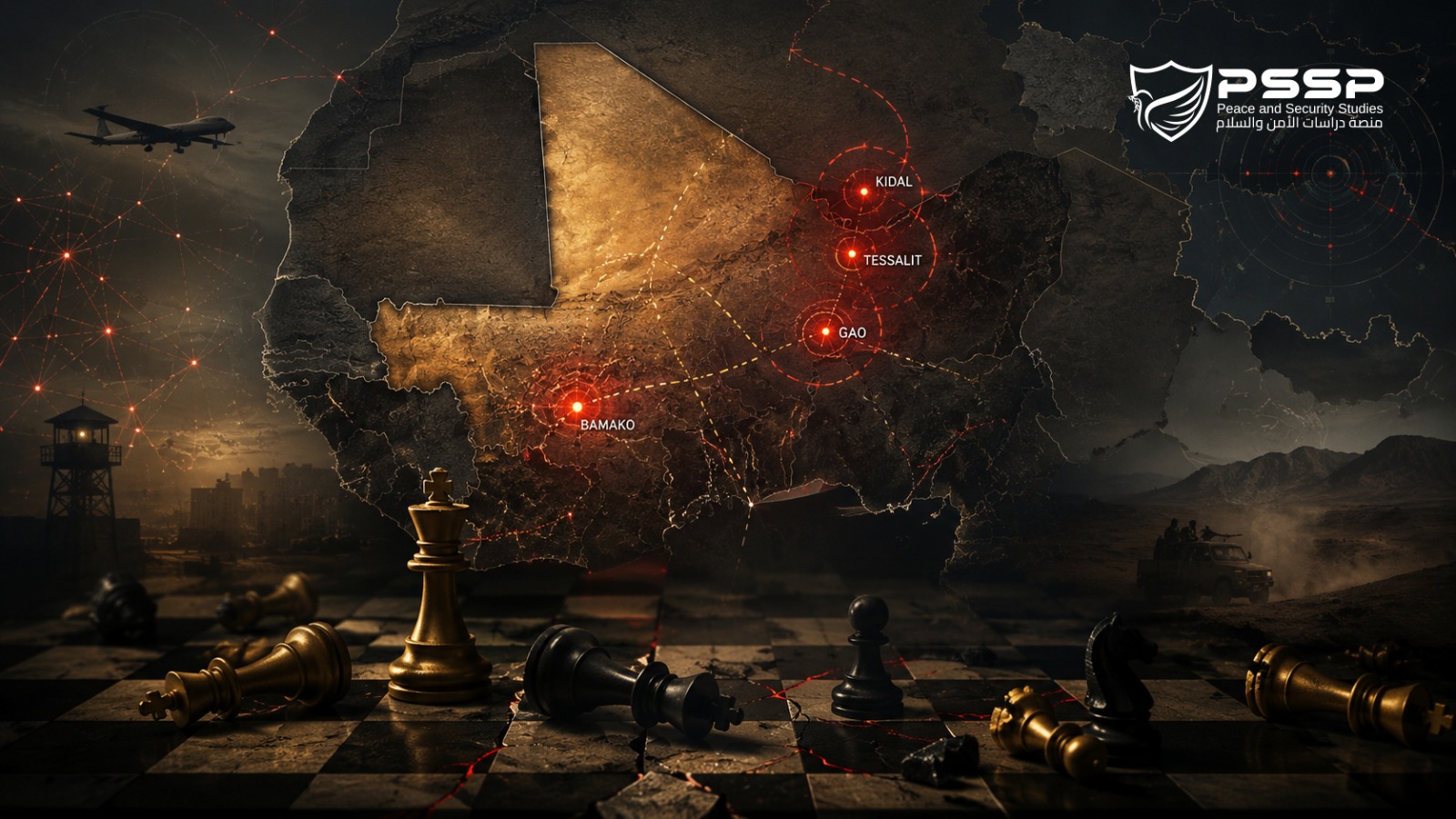
The dawn of April 25, 2026, was not merely an isolated security incident in Mali; rather, it is viewed in a number of open reports and analyses as a potential turning point in a fragile trajectory of political and security balances formed in recent years. The coordinated attack targeting Bamako and regions in the North reflects, according to multiple readings, an evolution in the tactics of armed groups, just as it indicates a deeper shift in the nature of the conflict itself.
In this context, field data emerges indicating the existence of operational intersection levels between the “Jama’at Nusrat al-Islam wal-Muslimin” (JNIM) and the “Azawad Liberation Front.” This proposition remains a subject of debate among observers given the ideological and political divergence between the two parties. However, the mere circulation of this hypothesis reflects the possibility of reshaping the map of armed actors beyond the traditional frameworks for analyzing the conflict in Mali.
At the level of the capital, Bamako, corroborating media sources indicate that recent operations have transcended the scope of direct military targeting to approach the vicinity of sensitive sovereign institutions. On Sunday, April 26, 2026, the Malian government confirmed the death of Defense Minister General Sadio Camara after sustaining severe injuries from the targeting of his residence in Bamako. This represented a pivotal shift in the military command structure and caused noticeable confusion within its leadership pyramid [1].
Conversely, according to open field reports, the North is experiencing a state of continuous instability, with frequent changes in the control of strategic areas. Recent developments have recorded a retreat in the positioning of government forces in areas such as Kidal and Tessalit, alongside ongoing clashes in the vicinity of Gao. These shifts, despite varying estimates regarding their scope, reflect the erosion of the capacity to establish stable contact lines on the ground.
Within this framework, the partnership with Russia remains a central axis of analytical debate. While the authorities rely on increasing military and technical support, multiple readings indicate that the effectiveness of this support is still being tested, especially in irregular conflict environments that require precise local intelligence capabilities that cannot be entirely replaced by technical or aerial superiority.
Corroborating reports also point to the existence of tensions within the military institution, whether at the level of operational coordination or the distribution of roles between local elements and external backers, which reflects on the efficiency of field performance on certain fronts. Politically, this escalation cannot be separated from the broader context of previous settlement attempts during 2025, which faced implementation challenges or receded as trust between the parties eroded, thrusting the military track back as the dominant option for managing the conflict.
Internally, there are growing indications of reopening the debate regarding the limits of the traditional security approach, amid a growing realization that the roots of the crisis transcend the military dimension to encompass issues of identity, political representation, and the redistribution of power between the center and the peripheries.
Preliminary Assessment of the Trajectory of Strategic Vulnerability
Based on these data, some analysts believe that Mali may be on the verge of entering a phase that can be described—cautiously—as “strategic vulnerability”; that is, a decline in the state’s capacity to maintain a cohesive protection system internally or through external alliances. However, this description remains more of an open analytical framework than a definitive conclusion.
In this context, several potential scenarios can be identified:
First: Repositioning of external partnerships: Developments may lead to a reassessment of the roles of external partners, including Russia, whether by reducing engagement or restructuring the nature of support, which could result in temporary security vacuums.
Second: Expansion of the regional nature of the conflict: The cross-border intertwining of armed networks makes the spillover of tension into neighboring countries a viable possibility, whether directly or indirectly, thereby raising the level of regional risks.
Third: A more systematic internationalization of the crisis: The severity of mounting security and political pressures could prompt the reintroduction of the Malian file within more systematic international frameworks, whether through multilateral organizations or coordinated regional initiatives. This trajectory reflects the transition of the crisis from its internal scope to a broader regional space, especially given what international reports indicate regarding the emergence of an “intelligence and aerial vacuum” following the withdrawal of Western powers, which contributed to enhancing the freedom of movement of armed groups across borders [2]. Furthermore, field data shows that reliance on the Russian “Africa Corps” has not succeeded in consolidating control over certain strategic centers, including Kidal, raising questions about the current security approach’s ability to achieve sustainable stability. In this context, Mali’s stability directly reflects on the security of neighboring countries, which have come to view northern Mali as a potential domain for the spread of transnational threats. The success of any internationalization track remains contingent upon the ability of local actors to unify a cohesive negotiating stance toward external initiatives, reducing the risks of the crisis turning into an arena of open international competition among external actors.
Fourth: The scenario of internal political fluidity (instability): This scenario involves the possibility that escalating security pressures coincide with potential tremors within the central authority structure, which could lead to a phase of complex political instability. The targeting and loss of pivotal figures in the military command pyramid, such as Defense Minister General Sadio Camara, alongside recent announcements by the Military Public Prosecution in Bamako regarding accusations of the “involvement of active and dismissed political and military figures in planning and coordinating the recent attacks” [3], could lead to a divergence of views within decision-making circles regarding the management of the upcoming phase. This would reflect on the level of institutional cohesion and the state’s capacity to control the security and political tempo. The evolution of this trajectory is partly linked to the authority’s ability to contain the accumulated field and political repercussions and reproduce a minimum level of harmony within its vital institutions.
Conclusion
The crisis in Mali today does not appear to be merely a traditional security test, but rather a multi-level trajectory that reshapes the relationship between the state and the geographical and social space it governs. Amidst the multiplicity of actors and the intertwining of local, regional, and international levels, the question remains open regarding the state’s capacity to produce a new stability formula that goes beyond crisis management toward re-establishing political and security balance.
Footnotes and References:
[1] “Announcement of the death of Malian Defense Minister Sadio Camara”, Agence de Presse Africaine (APA News), April 26, 2026 (News video), available at:
https://m.youtube.com/watch?v=rC2LZYD_mpw
[2] “Au Mali, un partenariat fragilisé entre la Russie et la junte face à l’offensive jihadiste”, France 24, April 29, 2026, available at:
https://www.france24.com/fr/afrique/20260429-mali-un-partenariat-fragilise-entre-la-russie-et-la-junte-face-offensive-jihadiste-africa-corps-wagner
[3] “Mali: ‘Africa Corps’ announces the elimination of 150 terrorists on the Mauritanian border”, Asharq Al-Awsat, May 2, 2026, available at:
https://aawsat.com/العالم/أوروبا/5268901-مالي–الفيلق–الأفريقي–يعلن–القضاء–على-150-إرهابياً-على–حدود–موريتانيا